Why the Basketball Key Has Its Shape
Understand why the basketball key has its shape, where lane restrictions apply, and how to read crowded plays near the basket with less guesswork.
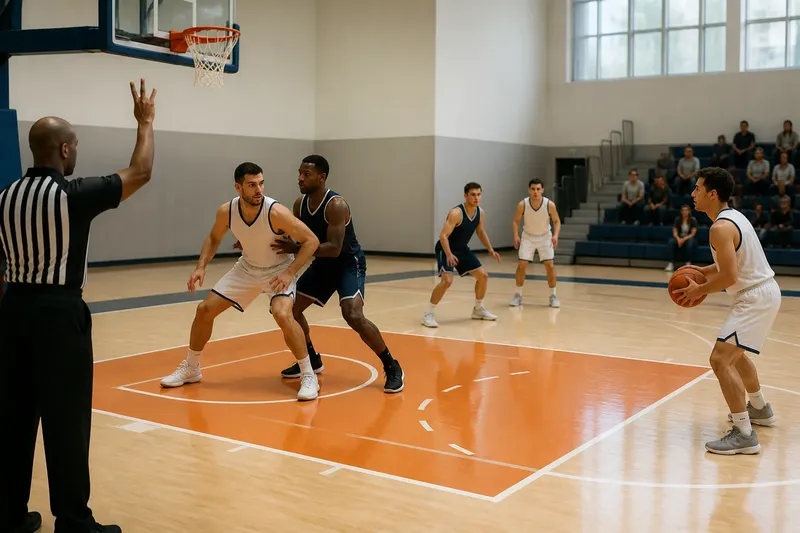
A center posts up on the block, a teammate holds the ball on the wing, and the referee begins a visible count. The basketball key—the painted lane beneath the hoop—helps explain why that moment can matter, even though players are free to move through the area.
Shape and purpose
The key extends from the baseline toward the free-throw line, directly beneath the basket. Its older, narrower shape resembled a keyhole; many modern court markings form a long rectangle instead. Lane dimensions and some details vary by competition, so use the lines on the court and the rules that govern that game.
The markings provide boundaries for particular restrictions, organize player positions during free throws, and make movement near the basket easier to judge. The lane is not a general no-standing zone. Players can enter and occupy it during ordinary play; the rules address specific actions and timing.
It helps to identify the situation before interpreting a call: an offensive player posting up, a defender protecting the basket, or players lining up for a free throw. The same painted space has different rules in each case.
Key and restricted area
The key is the larger lane. The restricted area is a smaller marking near the basket, often drawn as an arc inside the lane. It is associated with certain contact and defensive-position rules, while the lane has its own restrictions. The markings are close together, but they do not mean the same thing.
Competition rules can also differ in lane dimensions and defensive restrictions. For a particular game, the governing rulebook determines the applicable rules; the court markings help you see where those rules apply.
Offensive lane counts
Many rule sets restrict how long an offensive player may remain in the opponent’s lane while the player’s team controls the ball in the frontcourt. The count concerns continued presence, not how often the player touches the ball. The permitted time and exceptions depend on the competition.
Movement can matter. Some rules account for a player who is actively leaving the lane or making an immediate scoring attempt, but the details are not identical everywhere. In particular, stepping out and later cutting back in does not automatically reset the count under every rule set. The applicable competition’s rulebook governs whether and when a count resets.
Say a fictional team has the ball on the wing while its center waits in the lane. The official begins counting, and the center steps completely out before returning for a cut. To decide what follows, a viewer would check the competition’s rulebook for its reset conditions, then watch the referee’s count and the center’s position. If that rule set treats the exit as a reset, the count starts anew; if it does not, the original count may continue. If the center remains in the lane beyond the permitted time, the likely call is an offensive violation and a change of possession.
When a whistle surprises you, check the sequence in this order:
- Observe whether the player was on offense and in the opponent’s lane. If so, check whether the team controlled the ball in the frontcourt; if not, an offensive three-second call may not fit.
- Observe whether the player stayed in the lane or left it. If the player stayed, consider the count; if the player left, consult the rulebook for that competition’s reset rule.
- Observe whether the player was moving out or making an immediate scoring attempt. If either applies, check for a relevant exception; if neither does, assess the ordinary count.
- Observe the referee’s signal and the possession that follows. If the reason remains unclear, identify the competition and check its rule language rather than assuming every league uses the same procedure.
Attackers do not need to avoid the paint. They need to use it with movement and timing rather than stationing a teammate there indefinitely while the rest of the possession develops elsewhere.
Defensive lane rules
Offensive three seconds and defensive three seconds are not interchangeable. Some competitions restrict how long a defender may stay in the lane without actively guarding an opponent; others do not use that restriction in the same way.
Where a defensive restriction applies, a defender may need to leave the lane or actively guard an opponent. The precise meaning of active guarding and the rule’s conditions come from the competition’s rulebook. A long stay near the basket alone does not tell you whether a violation occurred.
After a whistle, note whether the defender was in the lane, whether an opponent was being guarded, and whether the competition uses a defensive restriction. If the call still seems puzzling, check those details against that competition’s rules.
Free-throw positions
During a free throw, players occupy marked spaces along the lane while the shooter stands at the free-throw line. The spaces organize the lineup; players must also follow the applicable restrictions on entering the lane and moving before the ball is released.
A lane violation may involve entering too early or failing to occupy a required position. Its consequence can depend on who committed it, whether the shot went in, and the competition’s rules. To follow the play, identify the shooter and lane players, watch for movement before release, then note whether the shot was made and which side the official signals against.
What should you watch?
Can players stand in the key?
Yes. The key is not reserved for one team, and players may move through or occupy it during play. A violation depends on a specific rule and situation, not simply on being in the paint.
Does stepping out reset three seconds?
It depends on the applicable competition’s rulebook, including how it defines leaving the lane and when a count restarts. Watch the player’s movement and the referee, but use that rulebook to settle a disputed reset.
Is the key the same as the restricted area?
No. The key is the larger lane, while the restricted area is a smaller marking near the basket. Each is tied to different rules.
Do all competitions use defensive three seconds?
No. Some competitions have a defensive lane restriction, and others do not apply one in the same way. Check the rules for the game you are watching before interpreting a defender’s long stay.
Reading the lines
The lane makes close-range traffic easier to interpret by giving players and officials a shared boundary. Its lines also organize free-throw positions and provide a visible reference for rules about player movement.
When a referee whistles near the hoop, do not decide from location alone. Ask who had possession, whether the play involved a free throw, and whether the player was attacking or defending. Then distinguish the key from the smaller restricted area. For the basketball key, the most useful viewing habit is to pair what you see—position, movement, and timing—with the rulebook for that competition.
It is not worth memorizing every league’s wording during a live possession. Notice the sequence first, then look up a recurring call when play is over; knowing which rule set applies can resolve an apparent inconsistency that the painted lines alone cannot.