The Handshake Before a Match and What It Signals
The handshake before a match marks mutual recognition between opponents and gives players a clear, respectful transition from arrival to competition.
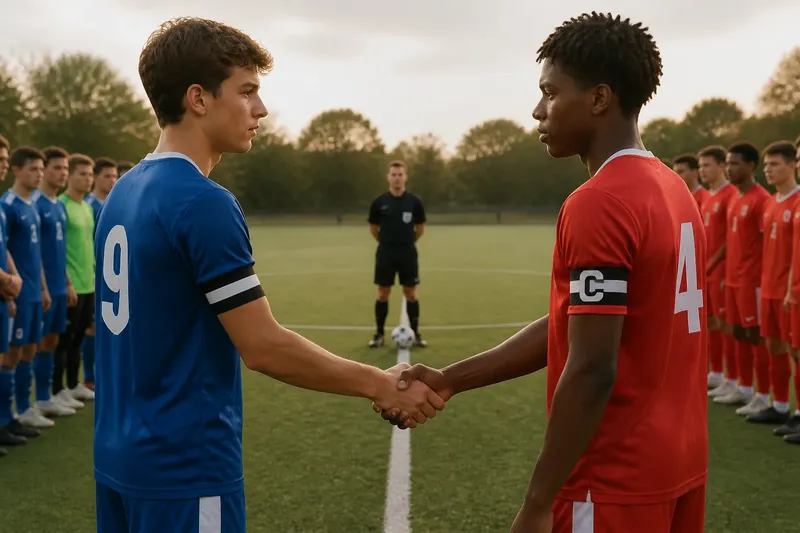
At a youth soccer field, two captains meet near the halfway line, shake hands, and turn toward their teammates. The handshake before a match is a small ritual with a clear purpose: it recognizes the people about to compete without pretending the competition itself is gentle or friendly.
A meeting before play
A match begins before the ball moves. Players arrive with different roles, loyalties, and goals. The pre-match handshake briefly brings them into the same scene: each side acknowledges that the other has a place in the contest.
That recognition is not the same as agreement. Opponents may dispute a call, press hard for an advantage, or feel frustrated by the result. The gesture marks a shared condition: each team has come to play under the same contest, with another group standing across from it.
In many sports, spectators see the ritual too. A line of players greeting one another can signal that the event has formally reached its start. Elsewhere, captains or coaches exchange the greeting, or the custom may be absent. Its form depends on the sport, level of play, and local practice.
What the gesture says
A handshake can carry several meanings at once. It can say, “I see you as my opponent,” and also, “I accept that we are here to compete.” It is a compact social signal, not a promise that everyone will feel warmly toward one another throughout the match.
Its restraint matters. The greeting is brief, reciprocal, and usually repeated across a group. No one needs to make a speech or claim a deep personal connection. A nod or handshake lets participants acknowledge one another without making the match less serious.
Say a school volleyball team arrives tense for an away game, with the home players lined up beside the net. The captains step forward, exchange handshakes, and signal their teammates to form two facing lines. Each player greets the person opposite, then walks to the assigned court position; the official checks that the teams are ready, and the players turn their attention to the opening serve. Those visible actions create a clear transition from arrival to competition. The ritual does not settle nerves or decide the match; it gives the occasion a recognizable threshold.
Ritual, not rule
It helps to distinguish a customary greeting from a condition of play. A handshake may be expected by a team, league, or community, but it does not generally define how points are scored or determine who wins. The contest has its own rules, officials, and outcomes.
That distinction keeps the gesture in proportion. A player who shakes hands has not conceded anything. A player who competes intensely afterward has not contradicted the greeting. The ritual belongs to the social frame around the match; the rules govern what happens inside it.
Customs can change. Some teams greet before play, others reserve a line of handshakes for the end, and some use a wave or brief acknowledgment instead. Where a league or event specifies a protocol, its directions take precedence; otherwise, participants can follow the established local custom and keep the exchange respectful.
Why timing matters
Before a match, the handshake looks ahead. It recognizes opponents before the result exists, when neither side can claim victory or demand consolation. The greeting treats participation itself as the point of contact, rather than making respect depend on who wins.
After a match, the same gesture can mean something slightly different. It may acknowledge effort, mark the end of direct competition, or offer a civil close after a difficult game. Before play, it opens the shared occasion; afterward, it helps participants leave it. The movement may look identical, while its place in the sequence changes its meaning.
What is not worth the effort is trying to read a whole personality from the firmness, duration, or expression of one handshake. A quick greeting may reflect nerves, habit, or simple focus. The custom works best as a shared signal, not a test of character.
What should players expect?
Do all sports use a pre-match handshake?
No. Some sports and teams make it part of the occasion, while others use different greetings or none at all. Follow the local custom rather than assuming every match uses the same script.
Does shaking hands mean opponents are friends?
Not necessarily. It marks mutual recognition and a willingness to take part in the contest; friendship is a separate relationship that may or may not exist.
Can a team compete fiercely after greeting its opponents?
Yes. The greeting acknowledges the people involved; it does not ask players to soften their effort or abandon their tactical aims. Respect and intensity can occupy the same match.
What if someone cannot or does not want to shake hands?
A nod, wave, or other respectful acknowledgment can serve the same social purpose. Participants should respect personal boundaries and follow event guidance without turning the exchange into a public confrontation.
A threshold for rivals
The handshake before a match is neither a truce nor a miniature version of the game. It is a threshold: one brief moment in which opponents recognize one another before their roles narrow to competing sides. The score will later describe what happened in play. The greeting marks that both sides were present to make the contest possible.
That is why the custom can remain meaningful even when it is quiet or routine. A simple acknowledgment gives the match a human beginning while leaving its outcome to the play that follows. When you watch the next pre-match greeting, notice what players do immediately afterward: that small shift from greeting to position is the ritual’s clearest sign that competition is about to begin.